 English
 Arabic
 Chinese (Simplified)
 Dutch
Dutch French
 German
 Italian
 Portuguese
 Russian
 Spanish
Case of the Week: A Cure for Pulsatile Tinnitus After Brain Surgery
Date: 10/15/2025
Reason for Consultation
A 64-year-old patient presented with severe pulsatile tinnitus, a constant “whooshing” sound in sync with the heartbeat.
The tinnitus developed a few months after surgery for a subdural hematoma and worsened when lying down, severely disrupting the patient’s sleep.
Imaging & Diagnosis
A cerebral angiogram was performed by one of our neurointerventional surgeons, Dr. Alejandro Santillan, to identify any underlying vascular causes.
Findings
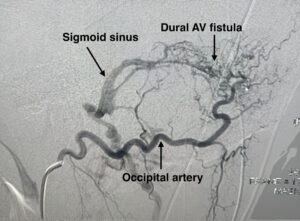
The angiogram revealed a Type I dural arteriovenous fistula (DAVF) supplied by the left occipital artery, with venous drainage into the left sigmoid sinus and deep cervical veins. This abnormal connection between arteries and veins created turbulent blood flow, the source of the patient’s pulsatile tinnitus.
Treatment: Endovascular Embolization
The patient underwent minimally invasive endovascular embolization, performed by Dr. Santillan and the neurointerventional surgery team at one of our partner hospitals.
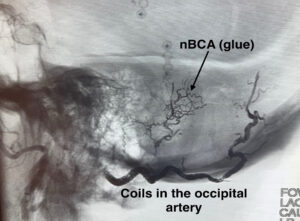
Since transvenous access was not possible, the fistula was treated transarterially. Using microcatheters, the team delivered n-butyl cyanoacrylate (nBCA) and coils into the abnormal vessels, completely sealing the fistula.
Results
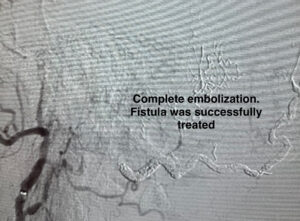
The outcome was remarkable: the pulsatile tinnitus resolved immediately after the procedure. Follow-up imaging confirmed complete occlusion of the dural arteriovenous fistula with no residual shunting.
Discussion
Pulsatile tinnitus is often a warning sign of a vascular abnormality, rather than an ear-related problem. In this case, the DAVF likely developed as a delayed complication following prior cranial surgery.
Prompt diagnosis and treatment are essential to prevent further complications such as venous hypertension or intracranial hemorrhage.
Endovascular embolization remains the gold-standard, minimally invasive cure, often providing instant relief from symptoms.
If you are experiencing pulsating tinnitus, please contact your primary care provider (PCP) or otolaryngologist (ENT) for further evaluation. IntelliRad Imaging’s clinic can schedule you for a diagnostic cerebral angiogram with a referral from your PCP or ENT.
